AFIN8003 Week 7 - Credit Risk II: Loan Portfolio and Concentration Risk

Banking and Financial Intermediation

Dr. Mingze Gao

Department of Applied Finance

2026-04-21

Credit Risk II: Loan Portfolio and Concentration Risk

Why this week matters

A cautionary tale

In March 2023, Silicon Valley Bank collapsed in 36 hours. Every one of its loans was performing. What killed it? Concentration. Its depositors were almost all Bay-Area tech startups, and its asset book was loaded with long-duration Treasuries. When one sector caught cold, the whole bank got pneumonia.

  • In the last couple of years, three of the four largest bank failures in U.S. history (SVB, Signature, and First Republic) were concentration stories, not one-loan stories.
  • Individual due diligence is not enough. Portfolio risk ≠ sum of loan risks.
  • This week: how to measure concentration, diversify it away, or sell it off with derivatives.

Roadmap

  • In Week 6, we measured default risk on individual loans.
  • FIs hold portfolios of loans — so credit risk must be measured and managed in a portfolio context.
  • This week we cover:
    1. Simple models of concentration risk (migration analysis, concentration limits)
    2. Modern Portfolio Theory applied to loans (Moody’s RiskFrontier)
    3. Regulatory approaches to concentration
    4. Credit derivatives (forwards, options, CDS) — how FIs separate credit risk from the lending relationship

Simple models of loan concentration risk

Simple models

Caution

A large credit risk exposure to a single borrower — or a group of borrowers exposed to the same risk factor — poses a potential threat to a bank’s safety and soundness.

  • Regulations limit such exposure, so individual loans rarely cause bank failures outright.
  • The real danger: pools of loans that look different but share the same risk driver behave identically in a downturn.
  • Think of the 2008 GFC — mortgages, CDOs, structured credit, MBS, and derivatives were marketed as different products but were all bets on U.S. house prices. When the one underlying factor turned, everything turned.

The hidden-correlation trap

Products with different names, sold by different business units, can still share the same underlying risk. A bank’s “diversified” book may be one bet in disguise.

Two simple models widely used to measure concentration risk:

  1. Migration analysis
  2. Concentration limits

Simple model: migration analysis

  • Track credit ratings of certain types of loans or certain sectors, either externally from credit rating agencies or internally.
  • If actual rating deteriorates faster than historical experience, limit lending to that loan class or sector.
  • Historical credit migration measured through loan migration matrix (or transition matrix).
Table 1: Example loan migration matrix
AAA-A BBB-B CCC-C Default
AAA-A 0.85 0.10 0.04 0.01
BBB-B 0.12 0.83 0.03 0.02
CCC-C 0.03 0.13 0.80 0.04

Table 1, for example, shows the transition probabilities of loans that began the year with a certain credit rating being upgraded/downgraded to a certain rating, or default.

  • The probability of AAA-rated loan at the start of a year being downgraded to BBB to B by the year’s end is 0.10.
  • The probability of AAA-rated loan at the start of a year being downgraded to CCC to C by the year’s end is 0.04.
  • The probability of AAA-rated loan at the start of a year defaults by the year’s end is 0.01.

Simple model: migration analysis (cont’d)

In practice, FIs use migration matrices with many more rating classes (S&P uses 20+).

Migration analysis is also applied to credit card and consumer loan portfolios.

Where migration analysis can mislead you

  • Historical data only — “last war” risk. Matrices built on 2010s data missed COVID-era dislocations.
  • Rating agencies lag — downgrades typically arrive after trouble is visible. By the time Moody’s cuts, the market has already repriced.
  • Point-in-time vs through-the-cycle — the same rating can mean different things across agencies and time.

Discussion

Lehman Brothers was rated A by S&P five days before its September 2008 bankruptcy. What does that tell you about relying on migration analysis alone?

Simple model: concentration limits

  • Caps the maximum loan size to an individual borrower, sector, or geographic area.
  • Used to reduce exposure to some industries and increase it in others.
  • Aggregate limits applied to industries whose performance is highly correlated.
  • Regulatory floors:
    • US (OCC): loans to a single borrower capped at 15% of bank’s capital (25% if fully secured).
    • Australia (APRA APS 221): large exposures to a single counterparty (or group) generally capped at 25% of Tier 1 capital; tighter 15% limit applies between domestic G-SIBs.

\[ \text{Concentration limit} = \text{Maximum loss as a percentage of capital} \times \frac{1}{\text{Loss rate}} \]

Example

If an FI’s manager is unwilling to permit losses exceeding 15% of the FI’s capital, with an estimated loss rate in a particular industry of 40 per cent, then the manager should set a concentration limit on the exposure to that industry as \(15\%\times \frac{1}{0.4}=37.5\%\).

Simple model: concentration limits (cont’d)

Let’s look at a real Australian bank. BOQ’s FY2023 credit exposure — notice anything?

Table 2: Proportionate credit exposures of lending activities of BOQ FY23
Sector $m % of Total Exposure
Residential mortgages 62,738 77.8
Property and construction 6,887 8.5
Healthcare 2,763 3.4
Professional services 2,431 3.0
Agriculture 1,232 1.5
Transportation 606 0.8
Manufacturing and mining 682 0.8
Hospitality and accommodation 841 1.0
Other 2,453 3.0
Total 80,633 100.0

Discussion

77.8% in residential mortgages. Is BOQ “diversified” across 9 sectors — or is it essentially one big bet on Australian house prices? Compare this to the Big Four. This pattern is typical of Australian banks and is one reason APRA stress-tests them on a property-market downturn.

Loan portfolio diversification and Modern Portfolio Theory (MPT)

Loan portfolio diversification and MPT

MPT can be used to measure and control an FI’s aggregate credit risk exposure.

Any model that seeks to estimate an efficient frontier for loans needs to determine and measure three things:

  • The expected return on individual loans
  • The risk of individual loans
  • The correlation of default risks between loans

Expected return \(R_p\) of a portfolio of \(N\) assets:

\[ R_p = \sum_{i=1}^N X_i R_i \]

where

  • \(R_i\) is the expected return on the \(i\)th asset
  • \(X_i\) is the proportion of the asset portfolio invested in the \(i\)th asset (the desired concentration amount)

Loan portfolio diversification and MPT (cont’d)

Variance of returns (or risk) of the portfolio \(\sigma_p^2\) can be calculated as

\[ \begin{aligned} \sigma_i^2 &= \sum_{i=1}^N X_i^2 \sigma^2_i + \sum_{i=1}^N \sum_{j=1}^N X_i X_j \sigma_{ij} \\ &= \sum_{i=1}^N X_i^2 \sigma^2_i + \sum_{i=1}^N \sum_{j=1}^N X_i X_j \rho_{ij} \sigma_i \sigma_j \end{aligned} \]

where

  • \(\rho_{ij}\) is the correlation between the returns on the \(i\)th asset \(j\)th asset
  • \(\sigma_i^2\) is the variance of returns on the \(i\)th asset
  • \(\sigma_{ij}^2\) is the covariance of returns between the \(i\)th asset and \(j\)th asset

Loan portfolio diversification and MPT (cont’d)

The fundamental lesson of MPT is that by taking advantage of its size, an FI can diversify considerable amounts of credit risk as long as the returns on different assets are imperfectly correlated with respect to their default risk adjusted returns.

Code
import numpy as np
import matplotlib.pyplot as plt

# Define annualized returns and covariance matrix for two assets
mean_returns = np.array([0.04, 0.1])  # Expected annual returns for two assets
cov_matrix = np.array([[0.06, 0.02], [0.02, 0.10]])  # Covariance matrix of returns
individual_volatility = np.sqrt(np.diag(cov_matrix))  # Volatility of individual assets

# Define the number of portfolios to simulate
num_portfolios = 10000

# Initialize empty lists to store portfolio returns, volatilities, and weights
results = np.zeros((3, num_portfolios))

# Simulate random portfolios
for i in range(num_portfolios):
    # Generate random weights for the two assets
    weights = np.random.random(2)
    weights /= np.sum(weights)  # Ensure weights sum to 1

    # Calculate portfolio return and volatility (risk)
    portfolio_return = np.dot(weights, mean_returns)
    portfolio_volatility = np.sqrt(np.dot(weights.T, np.dot(cov_matrix, weights)))

    # Store the results
    results[0, i] = portfolio_volatility
    results[1, i] = portfolio_return
    results[2, i] = portfolio_return / portfolio_volatility  # Sharpe ratio

# Calculate the Global Minimum Variance Portfolio (GMVP)
inv_cov_matrix = np.linalg.inv(cov_matrix)
ones = np.ones(len(mean_returns))
weights_gmvp = inv_cov_matrix.dot(ones) / ones.T.dot(inv_cov_matrix).dot(ones)
gmvp_return = weights_gmvp.dot(mean_returns)
gmvp_volatility = np.sqrt(weights_gmvp.T.dot(cov_matrix).dot(weights_gmvp))

# Plot the efficient frontier
plt.figure(figsize=(10, 6))
plt.scatter(
    results[0, :], results[1, :], c=results[2, :], cmap="Blues", marker="o", alpha=1
)
plt.colorbar(label="Sharpe Ratio")

# Plot individual assets as red dots
plt.scatter(
    individual_volatility[0],
    mean_returns[0],
    # color="red",
    marker="o",
    s=100,
    label="Asset 1",
)
plt.scatter(
    individual_volatility[1],
    mean_returns[1],
    # color="blue",
    marker="o",
    s=100,
    label="Asset 2",
)
# Plot GMVP
plt.scatter(gmvp_volatility, gmvp_return, color="red", marker="X", s=100, label="GMVP")

# Set axis limits to start from 0
plt.xlim(0, np.max(results[0, :]) + 0.02)  # Add a small margin on the right
plt.ylim(0, np.max(results[1, :]) + 0.02)  # Add a small margin on the top

# Annotate the plot
plt.title("Efficient Frontier with Two Assets")
plt.xlabel("Volatility (Risk)")
plt.ylabel("Expected Return")
plt.legend(loc="upper left")
plt.show()
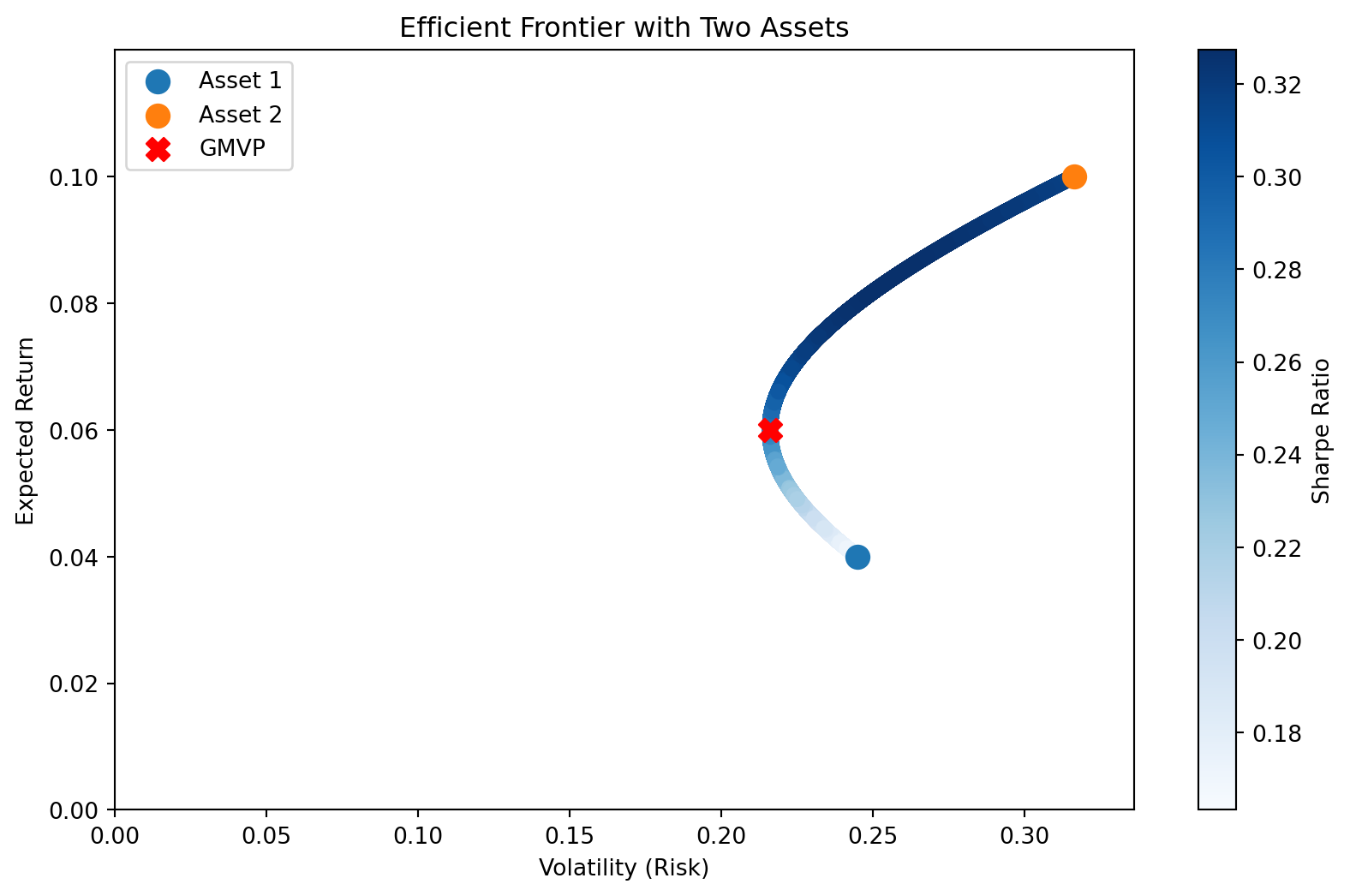
Figure 1: MPT and efficient frontier

Minimum risk portfolio (Global Minimum Variance Portfolio, GMVP)

  • Combination of assets that reduces the variance of portfolio returns on the lowest feasible level.

Moody’s RiskFrontier: the big picture

The problem: MPT needs three inputs — but for a loan portfolio, none of them are directly observable.

Code
flowchart LR
    A[Borrower<br/>financials] --> B[<b>Credit Monitor</b><br/>estimates EDF]
    B --> C[<b>RiskFrontier</b><br/>portfolio engine]
    D[~1,000 systematic<br/>factors via <b>GCORR</b>] --> C
    E[Loan terms:<br/>spread, fees, LGD] --> C
    C --> F[Portfolio<br/>R<sub>p</sub> and σ<sub>p</sub>]
    style B fill:#D6D2C4,stroke:#333
    style C fill:#A6192E,color:#fff,stroke:#333
    style D fill:#D6D2C4,stroke:#333

Borrower
financials

Credit Monitor
estimates EDF

RiskFrontier
portfolio engine

~1,000 systematic
factors via GCORR

Loan terms:
spread, fees, LGD

Portfolio
Rp and σp

Two Moody’s models in sequence:

  1. Credit Monitor → produces EDF (Expected Default Frequency) for each borrower
  2. RiskFrontier → plugs EDFs, LGDs, and correlations into MPT to get portfolio R and σ

Why not just use historical correlations?

Most loans never trade. There is no daily price series to correlate. RiskFrontier works around this by computing correlations from shared exposure to ~1,000 systematic factors (country, industry, region) rather than from return history.

RiskFrontier: the three MPT inputs

The whole model is just three numbers per loan, fed into standard MPT formulas.

Code
flowchart TB
    subgraph inputs [Inputs per loan i]
        R["<b>R<sub>i</sub></b> — Expected return<br/>= AIS<sub>i</sub> − EDF<sub>i</sub> × LGD<sub>i</sub>"]
        S["<b>σ<sub>i</sub></b> — Unexpected loss<br/>= √[EDF<sub>i</sub>(1−EDF<sub>i</sub>)] × LGD<sub>i</sub>"]
        P["<b>ρ<sub>ij</sub></b> — Default correlation<br/>from GCORR factor model"]
    end
    inputs --> MPT["Standard MPT:<br/>R<sub>p</sub> = Σ X<sub>i</sub>R<sub>i</sub><br/>σ<sub>p</sub><sup>2</sup> = ΣΣ X<sub>i</sub>X<sub>j</sub>ρ<sub>ij</sub>σ<sub>i</sub>σ<sub>j</sub>"]

Inputs per loan i

Ri — Expected return
= AISi − EDFi × LGDi

σi — Unexpected loss
= √[EDFi(1−EDFi)] × LGDi

ρij — Default correlation
from GCORR factor model

Standard MPT:
Rp = Σ XiRi
σp2 = ΣΣ XiXjρijσiσj

Symbol Meaning Source
AIS All-in-drawn spread (loan rate − cost of funds + fees) Loan contract
EDF Prob. of default in the next year Credit Monitor
LGD Fraction lost if default occurs Basel floors or bank estimate1
ρ Default correlation GCORR factor model

RiskFrontier: expected return and risk

Expected return — earn the spread, lose the expected loss:1

\[ \underbrace{R_i}_{\text{net return}} = \underbrace{AIS_i}_{\text{spread + fees}} - \underbrace{EDF_i \times LGD_i}_{E(L_i),\text{ expected loss}} \]

Unexpected loss — default is binomial, so σ has a closed form:2

\[ \sigma_i = UL_i = \underbrace{\sqrt{EDF_i(1-EDF_i)}}_{\sigma \text{ of a 0/1 default event}} \times \underbrace{LGD_i}_{\text{loss if default}} \]

Intuition

  • Expected loss (EDF × LGD) is already priced into the spread — it’s the cost of doing business.
  • Unexpected loss (σ) is what you hold capital against — the surprise.

RiskFrontier: where correlations come from (GCORR)

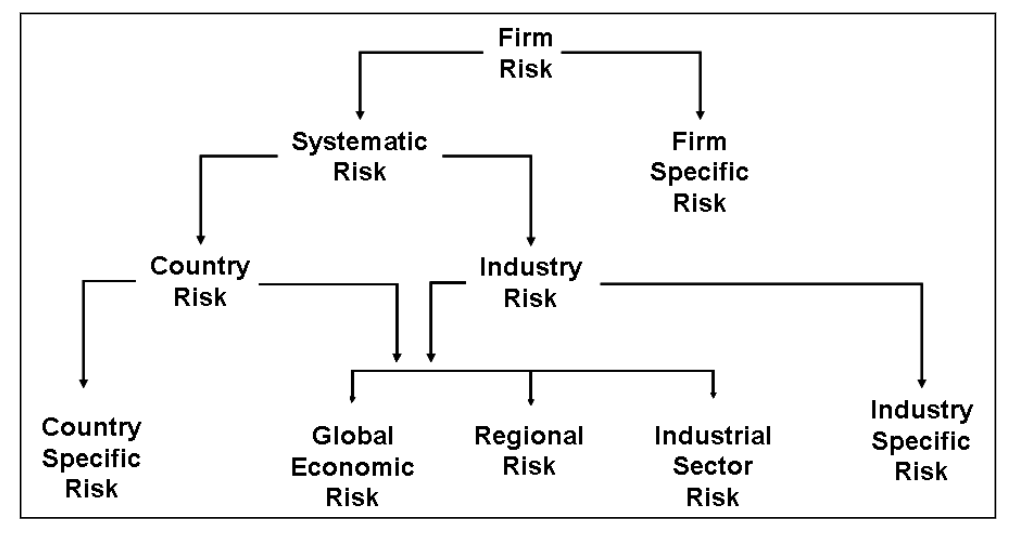
Default correlations between two loans cannot be directly observed. GCORR computes them via a factor model: two borrowers are correlated to the extent they share exposure to the same underlying risk factors.

Figure 2: Moody’s GCorr Corporate factor structure

Read Figure 2 this way

Each borrower’s asset return = global economy + region/country + industry + firm-specific noise. Two borrowers are correlated only through the shared branches of the tree. A Sydney miner and a Perth miner share the “Australia + Materials” branches — high ρ. A Sydney miner and a Berlin software firm share almost nothing — ρ near zero.

Moody’s Analytics RiskFrontier Model (example)

Suppose that an FI holds two loans with the following characteristics. Assume that the correlation \(\rho_{12}=-0.25\), what are the return and risk of the portfolio?

Loan \(i\) \(X_i\) Spread between loan rate and FI’s cost of funds Fees LGD EDF
1 0.6 5% 2% 25% 3%
2 0.4 4.5% 1.5% 20% 2%

The return and risk on loan 1 are:

\[ \begin{aligned} R_1 &= (0.05+0.02) - (0.03\times0.25) = 0.0625 \\ \sigma_1 &= \sqrt{0.03\times0.97} \times 0.25 = 0.04265 \end{aligned} \]

The return and risk on loan 2 are:

\[ \begin{aligned} R_2 &= (0.045+0.015) - (0.02\times0.2) = 0.056 \\ \sigma_2 &= \sqrt{0.02\times0.98} \times 0.2 = 0.028 \end{aligned} \]

The return and risk of the portfolio are then:

\[ \begin{aligned} R_p &= 0.6\times 0.0625 + 0.4\times 0.056 = 0.0599 \text{ or } 5.99\% \\ \sigma_p^2 &= (0.6)^2(0.04265)^2 + (0.4)^2(0.028)^2 + 2(0.6)(0.4)(-0.25)(0.04265)(0.028) = 0.0006369 \\ \sigma_p &= \sqrt{0.0006369} = 0.0252 = 2.52\% \end{aligned} \]

Regulatory models

  • Fed’s 1994 Ruling on Credit Concentration Risk
    • Subjective approach based on examiner discretion.
    • Rejected technical models — data and methods were too undeveloped at the time.
  • 2006 regulatory tightening
    • BIS: 10 principles on credit risk assessment and supervisory evaluation.
    • OCC: guidance on sound risk management for commercial real estate (CRE) lending.
  • OCC/Fed Joint Study (April 2013) — the numbers are striking:
Bank profile during GFC Failure rate
Construction loans > 100% of capital 13%
Exceeded BOTH construction AND total CRE criteria 23%
Did not exceed either criterion 0.5%

Takeaway

Banks that ignored the 2006 CRE concentration guidance were ~45× more likely to fail during the GFC than compliant banks. Concentration guidance is advisory — but the statistical case for it is overwhelming.

Use of derivatives to manage credit risk

Credit derivatives

  • Diversification is the first line of defence. Derivatives are the second.
  • The key insight: credit derivatives separate the credit risk from the lending relationship. A bank can keep the client, service the loan, and still offload the default risk to someone else.
  • Three main instruments: credit forwards, credit options, credit swaps (including CDS).

Why this innovation matters

Before credit derivatives (pre-1990s), the only way a bank could reduce credit exposure to a big client was to refuse the loan or sell it — both of which damage the relationship. Credit derivatives let the bank say “yes” and still cap its downside.

Credit forward contracts and credit risk hedging

  • A credit forward is a forward agreement that hedges against an increase in default risk of a firm (borrower).1
  • Specifies a credit spread on a benchmark bond issued by the borrower.
  • Used to hedge against credit deterioration (spread widening)
  • Spread is measured vs. a risk-free Treasury
  • Example: BBB bond trades at 2% spread over Treasury

Credit forward contracts and credit risk hedging (cont’d)

Market outcome Long position (hedger) Short position
Spread widens → credit quality worsens Gains (receives payment) Loses (makes payment)
Spread tightens → credit quality improves Loses (makes payment) Gains (receives payment)
  • If \(\phi_T > \phi_F\): Long receives \((\phi_T - \phi_F) \times MD \times A\)
  • If \(\phi_T < \phi_F\): Long pays \((\phi_F - \phi_T) \times MD \times A\)

where

  • \(\phi_F\) is the credit spread on which the credit forward contract is written

  • \(\phi_T\) is the actual credit spread on the bond when the credit forward matures

  • \(MD\) is the modified duration on the benchmark bond

  • \(A\) is the principal amount of the forward agreement

  • Long position protects against borrower credit quality getting worse

  • Short position benefits if borrower credit improves

  • Acts like a put-style hedge for lenders

Credit options

Use of options to hedge credit risk is a relatively new phenomenon. In September 2021, commercial bank holdings of credit options totaled $233 billion, which represented 6.05% of all credit derivatives outstanding.

  • A credit spread call option is a call option whose payoff increases as the (default) risk premium or yield spread on a specified benchmark bond of the borrower increases above some exercise spread.
  • A digital default option is an option that pays a stated amount in the event of a loan default (the extreme case of increased credit risk).

Credit (default) swaps (CDS)

The most important — and most controversial — credit derivative.

Explosive growth, then regulatory pushback:

Date US bank credit-derivative notional Note
2000 $426 billion Nascent market
March 2008 $16.44 trillion Pre-GFC peak
2009 $13.44 trillion Post-Lehman retrenchment
September 2011 $15.66 trillion ($15.31tn CDS) CDS dominance
September 2021 $3.9 trillion ($3.4tn CDS) Post-Dodd-Frank, central clearing

What caused the collapse?

Dodd-Frank (2010) pushed most standardized CDS onto central clearinghouses (CCPs), with initial-margin and variation-margin requirements that made speculative CDS much more expensive. Bilateral inter-dealer books shrank dramatically.

Why CDS exist:

  1. Credit risk is still the #1 cause of FI failure — more than interest-rate or FX risk.
  2. CDS let FIs keep long-term customer relationships while offloading default risk.

Basics of CDS

  • CDS Payments: The buyer makes periodic payments to the seller (quarterly, semi-annually, or annually) until the end of the swap or a credit event (e.g., default) occurs.
  • Settlement: Upon default, settlement involves either physical delivery of bonds (loans) or a cash payment.
    • The protection buyer receives a payment upon the occurrence of a credit event trigger, but the swap “expires worthless” if no trigger occurs.
  • No requirement that the CDS buyer actually owns the underlying reference securities.
  • The CDS buyer hedges its exposure to default risk, but there is still counterparty credit risk in the event that the seller fails to perform their obligations under the terms of the contract.1

We examine two types of credit swaps:

  1. total return swap
  2. pure credit swap

Credit swaps: total return swaps

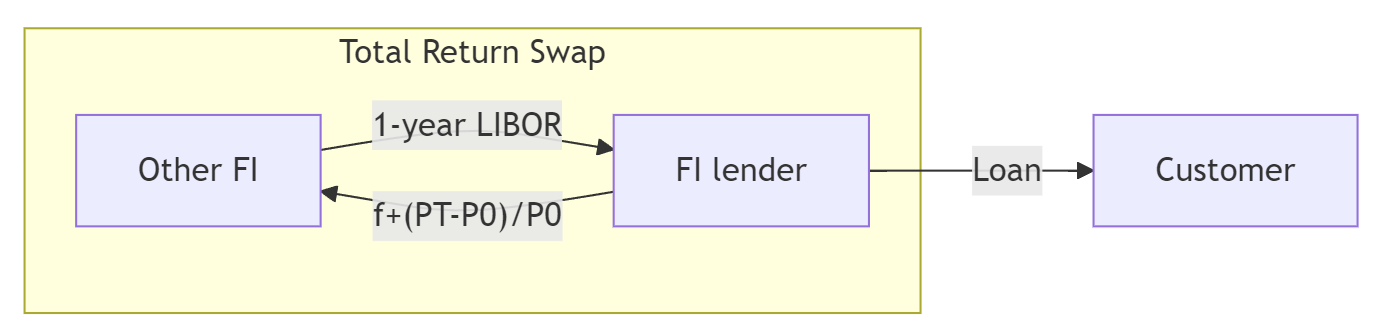
A total return swap involves swapping an obligation to pay interest at a specified fixed or floating rate for payments representing the total return on a loan or a bond (interest and principal value changes) of a specified amount.

The figure below illustrates a total return swap.1

The FI lender pays a fixed annual rate \(f\) plus changes in the market value of the loan and receives a variable rate payment (historically 1-year LIBOR; post-2023 SOFR in USD, AONIA/BBSW in AUD since LIBOR’s cessation in June 2023).

  • Interest rate risk remains — the TRS transfers credit and market risk of the asset, but the fixed vs floating mismatch is still an interest-rate exposure.

Credit swaps: total return swaps (cont’d)

Code
import numpy as np
import matplotlib.pyplot as plt

np.random.seed(8003)
# Parameters for the TRS
notional = 1_000_000  # Notional amount (1 million)
fixed_rate = 0.03  # Fixed annual rate paid by the TRS receiver (3%)
asset_volatility = 0.1  # Volatility of the asset's return (10%)
years = 5  # Time period of the TRS (5 years)
periods_per_year = 4  # Payments per year (quarterly)


# Generate the timeline for TRS payments
def generate_trs_timeline(
    notional, fixed_rate, asset_volatility, years, periods_per_year=4
):
    # Set up the timeline with quarterly periods
    total_periods = periods_per_year * years
    time_points = np.arange(1, total_periods + 1) / periods_per_year

    # Calculate the periodic fixed payment amount (quarterly)
    periodic_fixed_payment = (
        -notional * fixed_rate / periods_per_year
    )  # Fixed payment made by TRS receiver

    # Simulate random returns on the asset
    asset_returns = np.random.normal(loc=0, scale=asset_volatility, size=total_periods)

    # Initialize lists to store the results
    total_returns = np.zeros(total_periods)
    payments = np.zeros(total_periods)

    for period in range(total_periods):
        # Total return on the asset (positive or negative)
        total_return = notional * asset_returns[period]
        total_returns[period] = total_return

        # Net payment for the TRS receiver (positive if receiving total return, minus fixed payment)
        payments[period] = total_return + periodic_fixed_payment

    return time_points, payments, total_returns


# Simulate TRS payments with different asset volatilities
volatilities = [0.05]  # Different volatilities to simulate
simulations = {}

for vol in volatilities:
    timeline, payments, total_returns = generate_trs_timeline(
        notional, fixed_rate, vol, years, periods_per_year
    )
    simulations[vol] = payments

# Plot the timelines as bar charts
plt.figure(figsize=(12, 8))
bar_width = 0.2  # Width of each bar

# Generate bar charts for each volatility
for idx, (vol, payments) in enumerate(simulations.items()):
    plt.bar(
        timeline + idx * bar_width * 0.1,
        payments,
        width=bar_width,
        color="#A6192E",
        label=f"Volatility: {vol*100:.0f}%",
    )

# Customize the plot
plt.title(f"{years}-Year Total Return Swap Payments Example")
plt.xlabel("Time (Years)")
plt.ylabel("Net Payment Amount ($)")
plt.axhline(0, color="black", linewidth=1)
plt.grid(True)
plt.legend()

# Show the plot
plt.show()
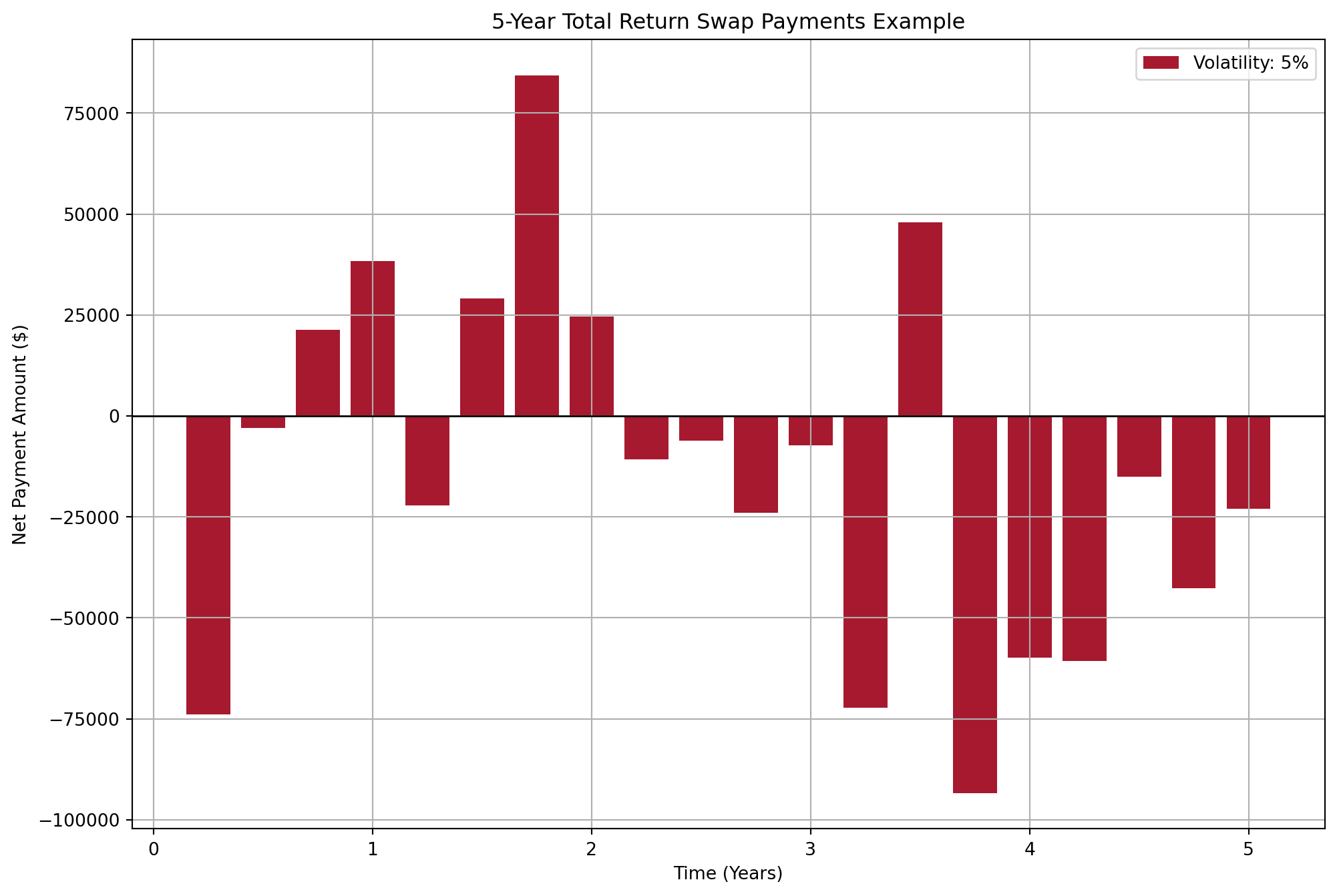
Figure 3: Total Return Swap Payments Example

Credit swaps: pure credit swaps

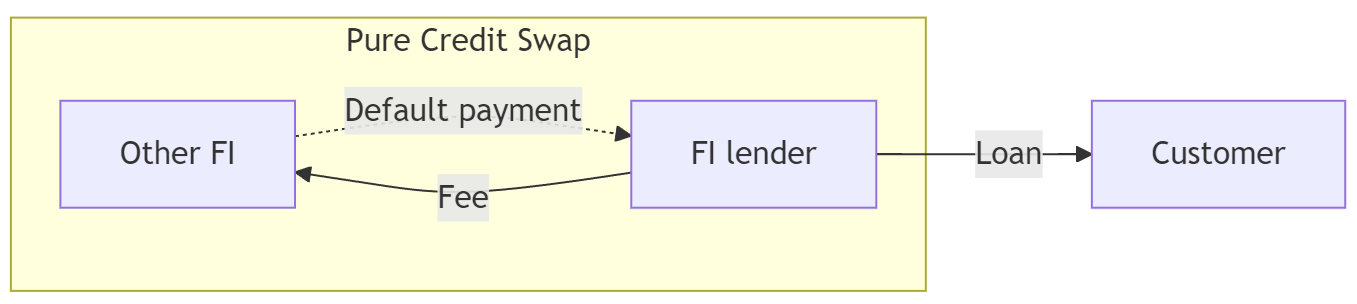
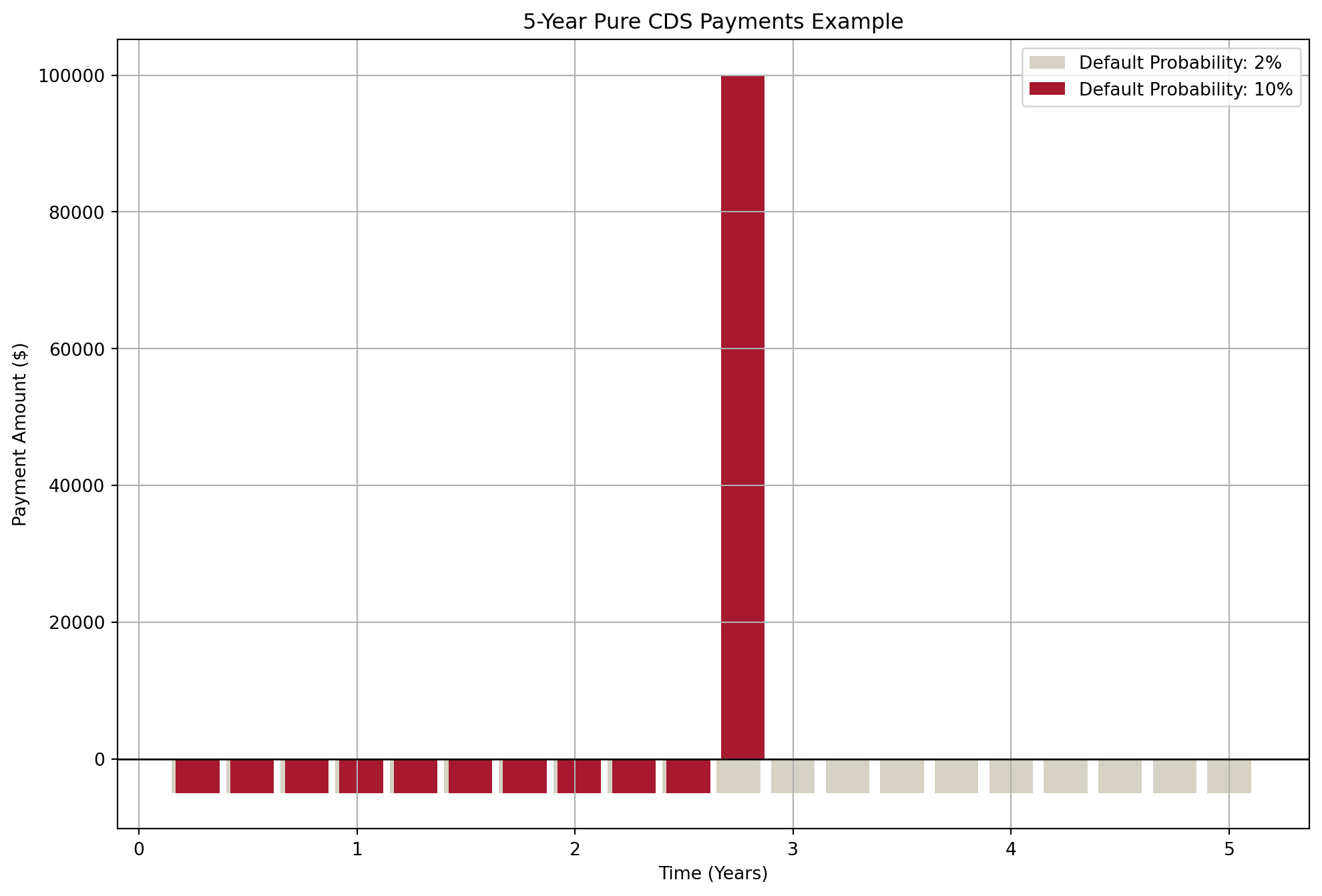
Interest-rate sensitive element stripped out leaving only the credit risk.

Similar to buying an insurance:

  • If default, the counterparty makes the default payment
  • If not default, the FI receives nothing from the counterparty.

Credit swaps: pure credit swaps (cont’d)

Code
import numpy as np
import matplotlib.pyplot as plt

np.random.seed(8003)
# Parameters for the CDS
notional = 1_000_000  # Notional amount (1 million)
cds_spread = 0.02  # Annual CDS spread (2%)
recovery_rate = 0.9  # Recovery rate in case of default (10%)
years = 5  # Time period of the CDS (5 years)
periods_per_year = 4  # Payments per year (quarterly)


# Generate the timeline for CDS payments
def generate_cds_timeline(
    notional, cds_spread, default_probability, recovery_rate, years, periods_per_year=4
):
    # Set up the timeline with quarterly periods
    total_periods = periods_per_year * years
    time_points = np.arange(1, total_periods + 1) / periods_per_year

    # Calculate the periodic payment amount (quarterly)
    periodic_payment = (
        -notional * cds_spread / periods_per_year
    )  # Negative for payments

    # Initialize lists to store the results
    payments = np.zeros(total_periods)

    # Simulate payments and default events
    for period in range(total_periods):
        if np.random.rand() < default_probability / periods_per_year:
            # Default occurs at this period
            default_loss = notional * (
                1 - recovery_rate
            )  # Positive for the payment received on default
            payments[period] = default_loss
            payments[period + 1 :] = 0  # No more payments after default
            break
        else:
            # Regular payment
            payments[period] = periodic_payment

    return time_points, payments


# Simulate multiple series with different default probabilities
default_probabilities = [0.02, 0.1]  # Different default probabilities
colors = ["#D6D2C4", "#A6192E"]

simulations = {}

# Generate timelines for each default probability
for prob in default_probabilities:
    timeline, payments = generate_cds_timeline(
        notional, cds_spread, prob, recovery_rate, years, periods_per_year
    )
    simulations[prob] = payments

# Plot the timelines as bar charts
plt.figure(figsize=(12, 8))
bar_width = 0.2  # Width of each bar

# Generate bar charts for each probability
for idx, (prob, payments) in enumerate(simulations.items()):
    plt.bar(
        timeline + idx * bar_width * 0.1,
        payments,
        width=bar_width,
        color=colors[idx],
        label=f"Default Probability: {prob*100:.0f}%",
    )

plt.title(f"{years}-Year Pure CDS Payments Example")
plt.xlabel("Time (Years)")
plt.ylabel("Payment Amount ($)")
plt.axhline(0, color="black", linewidth=1)
plt.grid(True)
plt.legend()
plt.show()
Figure 4: Pure CDS Payments Example

Finally…

Key takeaways

  1. Concentration, not individual default, is the usual killer. Loans that “look different” often share one risk factor.
  2. Migration analysis is useful but backward-looking — rating agencies lag reality.
  3. MPT applies to loans, with adaptations (RiskFrontier): expected loss = EDF × LGD, risk = √(EDF(1-EDF)) × LGD, correlations come from factor models (GCORR), not history.
  4. Derivatives separate credit risk from the lending relationship. TRS transfers total return; pure CDS transfers only default risk.
  5. Counterparty risk is real — AIG 2008 is the cautionary tale. Central clearing is the post-GFC response.

Suggested readings

References

Saunders, Anthony, Marcia Millon Cornett, and Otgo Erhemjamts. 2023. Financial Institutions Management ISE. 11th ed. McGraw Hill.